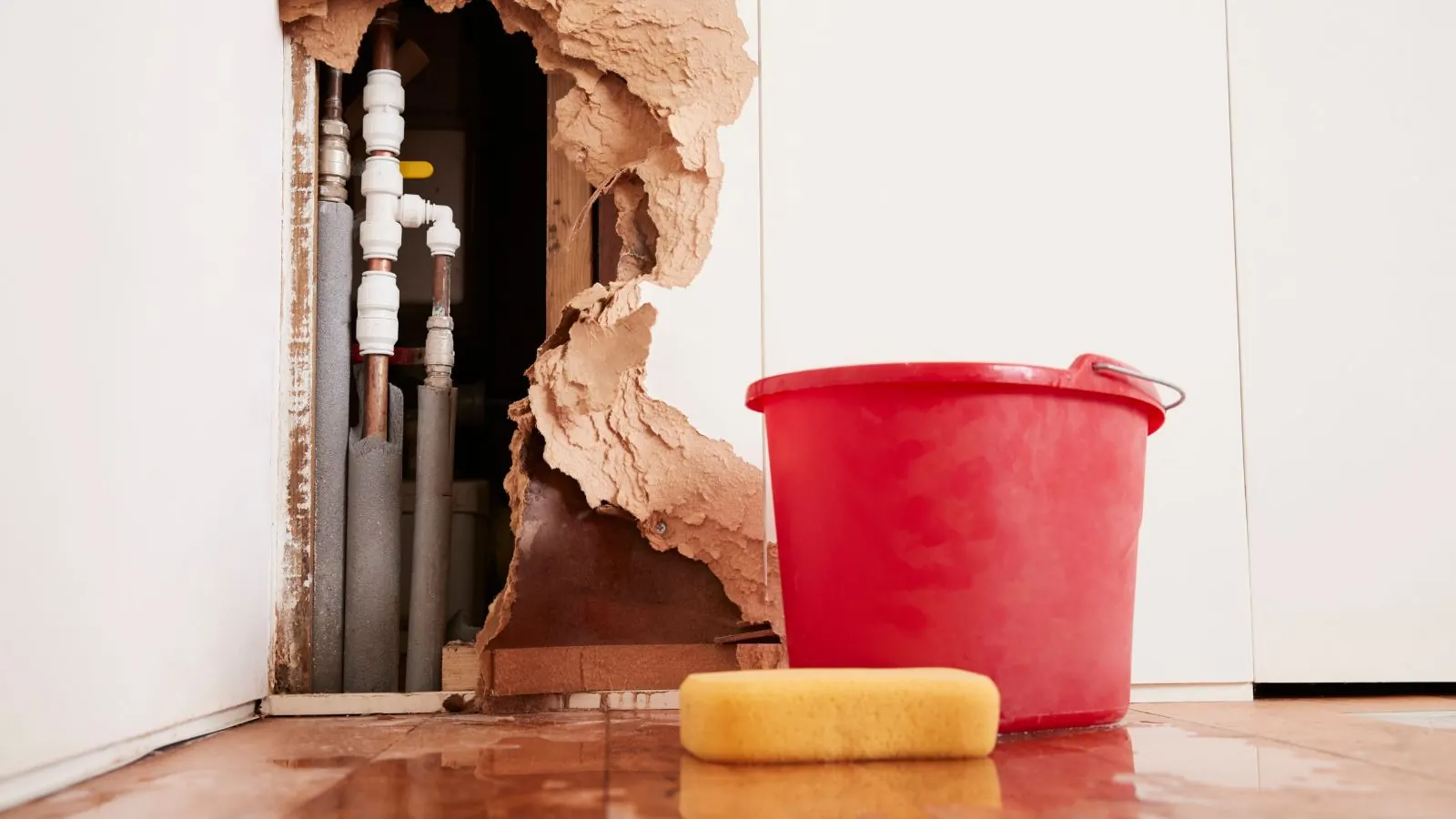
How Pipes Fail in Bellflower Homes
Bellflower does not have hard freezes, so a burst here is rarely ice. The usual causes are old supply lines that corrode from the inside, a fitting that lets go under normal pressure, a flexible connector that splits behind a toilet or sink, or a line damaged during other work in the wall.
The city's draft housing element reports that most homes in Bellflower were built before 1970. Houses that old can still carry original galvanized or copper lines, and a pinhole in one of them can spray into a wall cavity for hours before anyone notices.
What You See and What It Means
| What you see | What it usually means |
|---|---|
| Water running down a wall or from a ceiling | A supply line is open inside the cavity and the whole wall is likely wet. |
| A meter that spins with every fixture off | A hidden leak somewhere between the meter and the house. |
| Sudden low pressure at several faucets | A main or branch line has failed and water is escaping. |
| Warm or damp spots on a floor | A hot water line may be leaking under the surface. |
| A hissing sound inside a wall | Pressurized water is escaping from a split or loose fitting. |
Safety Steps for the First Hour
Close the shut-off valve at the fixture, or the main valve for the house if the source is not clear. The city has four water companies, so if you cannot find your valve at the meter, ask Public Works at (562) 804-1424 which company serves your address.
Keep power off in wet rooms if you can reach the panel without stepping into water. If water is near outlets, a panel or a ceiling light, stay out and call 911 or the electric utility.
- Open a faucet at the lowest point of the house to drain the remaining pressure.
- Lift electronics, rugs and books off the floor.
- Take photos and short video before you move anything.
- Keep children and pets out of the wet area.
- Do not run a household vacuum on standing water.
How the Cleanup Works
The crew starts with a moisture meter and a thermal camera to trace where the water went, since it follows studs and plates well past the visible wet spot. Standing water comes out with extraction equipment, and soaked carpet pad and baseboard are usually removed.
If the wall is wet inside, the crew cuts a clean flood line above the water mark so air can reach the cavity. Air movers and LGR dehumidifiers then run until the readings reach the drying goal. This follows the ANSI/IICRC S500 reference for water damage restoration, which we use as a guide and not as a certification claim.
Cleanup Compared With Plumbing Repair
We dry and clean the damage. We do not repair the pipe. A licensed plumber fixes the failed line, and the city's permit handout lists plumbing work among the jobs that need a permit, so ask Public Works at extension 2006 about your case.
Do not close up a wall until both are done. Drying and repair can overlap, but a patched pipe in a wet cavity only moves the problem. See emergency water removal for the extraction side and water damage repair for the rebuild that follows.
What Changes the Cost
Five factors move the price of a burst pipe job. They are how long the water ran, the water category and how many rooms and floors it reached. The last two are how many walls must be opened and how many days of drying equipment the readings call for.
A pipe that ran for ten minutes in a kitchen is a very different job from one that ran overnight into a hallway. Scope and price are explained before work starts.
Insurance Fit
A pipe that bursts suddenly is the classic sudden and accidental loss that many homeowners and renters policies cover, while a slow seep that went unnoticed for months often is not. The cost of fixing the pipe itself is often treated differently from the water damage it caused.
The California Department of Insurance says standard homeowners policies generally exclude flood, which is separate from a plumbing failure. Check your policy and call your insurer before major work. Photos and moisture logs support most claims.
Mistakes and Prevention
The common mistake is waiting for the water to stop on its own. Another is drying only the surface and closing the wall, which leaves a damp cavity that can grow mold. A third is cutting the wrong pipe while looking for the leak.
To prevent a repeat, replace braided supply lines that are several years old, know where your valve is, and have a plumber check pressure if fixtures knock or hammer.
Burst Pipe Cleanup in Nearby Towns
The same crews cover Downey and Lakewood, both of which have their own water providers and contacts listed on their pages.
Burst Pipe Water Damage FAQ
Yes. The dispatch line is open 24 hours a day, every day, including nights and holidays. Same-day response is offered when crews are available, and no arrival time is promised.
Use the fixture valve if you can see the source. If you cannot tell where the water is coming from, close the main. Then open a low faucet to relieve pressure.
No. A plumber repairs the line. We extract the water, open wet materials and dry the structure, and we coordinate timing so the wall is not closed too early.
Sometimes. Clean water that is caught quickly may let the drywall dry in place. Drywall that sags, crumbles or has sat for days is usually cut out and replaced.
It depends on the materials and humidity, so it is tracked with readings instead of a set number of days. Ask the crew to show you the readings at each visit.